
Here’s a reason (or two, or three…) why a lot of musicians still treasure vintage analog technology… In an era of increasingly computerized music production and artificial intelligence (AI), analog MIDI modules stand as evidence of the warmth, character, and irreplaceable sonic qualities that have mesmerized musicians for decades.
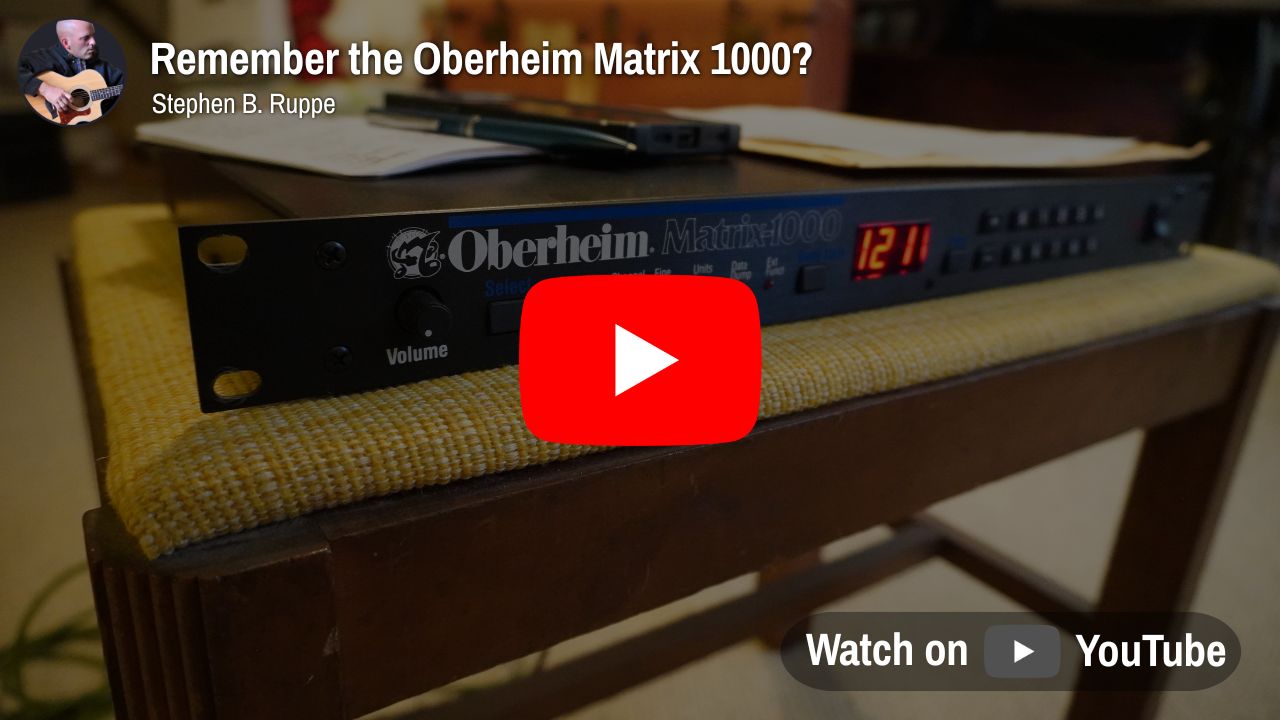
My Dad’s Oberheim Matrix 1000 YouTube Demo
Far from being remnants of a bygone era, vintage pieces of equipment, such as the Oberheim Matrix 1000, continue to hold a special place in the hearts of musicians, producers, and sound designers across styles. As of the writing of this blog post, you can still find this particular module for sale (used, of course) at places like: Reverb, eBay, etc. … Anywhere from $800 – $1500…
The Very Noticeable Warmth of Analog Technology
In contrast to digital synthesizers that produce tones, analog modules introduce subtle imperfections and harmonics, producing a rich, organic sound that is not easily duplicated elsewhere. Each module has its own unique personality – a slightly unstable oscillator, a temperamental filter, or a distinctive distortion.
That said, there are some really nice sounds produced by companies like Native Instruments. To be honest, even Logic Pro, Cubase, and Ableton have very high-quality sounds that can be used right out of the box. But, again, the digital manipulation isn’t exactly the same.
You might have heard the phrase “three-dimensional” sound at some point in your musical journey. Well, that’s what some of these vintage devices tend to produce when you hook them up. Vintage modules from manufacturers like Roland, Korg, and Yamaha are prized for their ability to create sounds with textures that just feel more alive. Whether it’s the punchy basslines of a Roland TB-303 or the lush pad sounds of a Yamaha DX7, these modules possess a sonic character that continues to inspire.
As for the Oberheim Matrix 1000…
The analog Matrix 1000 is a compact rack-mount MIDI module that contains 1,000 patches from the Matrix 6. It is basically a less expensive version of the keyboard-equipped Matrix 6 (Take a look at eBay; roughly $1,200–$1,800, or thereabouts). It shares the same synthesizer architecture as the Matrix 6. Each of its six voices is equipped with two digitally controlled analog oscillators (DCOs), a low-pass filter, 2 VCAs, 3 envelope generators, 2 LFOs, and 2 ramp generators. The range of sounds it produces is extensive and of good quality; however, parameter editing is only possible via MIDI, requiring an external MIDI editor such as MOTU’s Unisyn or Access’ Matrix Programmer. Additionally, sounds can be imported from the Matrix 6 using SysEx or software.
This rack module offers 195 “keyboard” sounds, 118 “strings,” 130 “woodwinds & perc,” 239 “synthesizer,” 119 “bass,” 74 “lead, and 125 “effects.” For the value, you won’t find a more affordable option to discover authentic analog Oberheim Matrix sounds in a compact format packed with more sounds than you’ll ever require!
Hands-On Sound Manipulation
A major benefit of analog MIDI modules is the hands-on experience of sound design. Unlike software plugins that rely on mouse clicks and computer interfaces, these modules feature physical knobs, sliders, and switches that provide immediate, intuitive control (Not so much for the outboard modules like the Oberheim, but…). You can adjust sound(s) in real time, creating an interactive, creative musical experience.
This practical method boosts artistic creativity and deepens engagement with your music. It encourages spontaneous creativity, letting every note reflect the mood, energy, and environment for an immersive musical passage. Transforming sound design into an artistic performance, it fosters a more intimate relationship with the instrument.
Dependability and Durability
Contrary to what many might expect, well-maintained analog MIDI modules can be incredibly reliable. Many units from the 1980s and early 1990s are still functioning perfectly (such as the Oberheim…), evidence of their solid engineering. It’s kind of nice to know that these modules can be repaired, calibrated, and maintained, contrary to digital devices that often become obsolete within a few years. Don’t cha just hate updating everything, or having to buy a newer version of something!?!?!?…
How easy it (apparently) is to repair some of these modules contributes to their sustainability. Instead of discarding an entire unit when a single component fails, technicians can often replace that component, extending the module’s life.
I personally have never tested my repair skills in such a way (I’ll stick to just changing out guitar strings for now), and you (might) have a slightly difficult time finding such a repair person depending upon where you live, but they’re out there (larger cities, I guess)…
Integration alongside Modern Music Production
Modern music production has not left analog MIy DI modules behind. Many contemporary electronic music producers deliberately incorporate vintage modules into their digital setups. MIDI retrofitting and conversion options allow these classic instruments to communicate easily with current computer-based music production systems.
The video above demonstrates (very quickly and simply) how to connect an old MIDI module to an amplifier, PA, or audio interface via a single 1/4″ instrument jack and a MIDI cable – using a Yamaha DX7 to trigger the sounds. Not demonstrated in the video is how to use two MIDI cables to simply connect the vintage module to your audio interface (didn’t have one available at the time – visiting my parents – it’s my Dad’s old Oberheim) to access the sounds using your current audio production setup. Perhaps, in another future video…
DAWs (Digital Audio Workstations) now offer sophisticated MIDI integration, allowing analog modules to be controlled and recorded with the same precision as software instruments. This bridging of analog and digital technologies guarantees that these vintage modules remain valuable and highly sought after in contemporary production.
Collector’s Value and Investment
Beyond their musical utility, analog MIDI modules have proven to be significant collectors’ items. Rare and well-preserved units can appreciate considerably in value, making them not merely musical instruments but also possible financial investments. Collectors (Not just musicians) are ever seeking out such pristine examples of legendary MIDI modules.
My Dad has considered selling his Oberheim, even his Yamaha DX7 (Juno 01, etc., the list goes on), and I hope to acquire some of the items before they are gone.
Genres and Creative Possibilities
From techno and house to experimental electronic music and film scoring, analog MIDI modules are used through a variety of musical landscapes. Their unique sound characteristics are especially valuable in genres that prize distinctive sonic textures and encourage creativity.
For instance, techno producers might use a vintage Roland TR-808 for its iconic drum sounds, while ambient musicians might use a Korg MS-20 for its complex modulation capabilities. Film composers appreciate the modules’ ability to create unique, otherworldly sounds that digital emulations struggle to reproduce.
I personally like the simple Chimes (Patch #121) sound that comes out of the Oberheim…
Conclusion
Analog MIDI modules are more than nostalgic curiosities: they offer a profound approach to sound creation which values character, hands-on interaction, and sonic depth. As music technology develops, these instruments remind us that innovation sometimes means maintaining and honoring the unique qualities of established technologies.
I guess you could say that’ still another way of saying you are nostalgically curious… BUT, THE OLD SOUNDS ARE JUST COOLER… At least, sometimes, anyway…
For musicians wanting to add depth, character, and a hint of historical authenticity to their sound, analog MIDI modules remain an incomparable resource…
UNtil Next Time,

Featured Image: My Dad’s Oberheim Matrix 1000. One of these days I’ll do a better, more deserving demo of this great piece of synth gear. View on My Flikr Account.